










Secrets of the vine & champagne
Champagne: one word says it all: dream of the prodigious adventure of champagne and its secret life a hundred feet underground; imagine the skill of chefs, the gourmet scents of a Marne region that maintains its traditions like historic monuments...
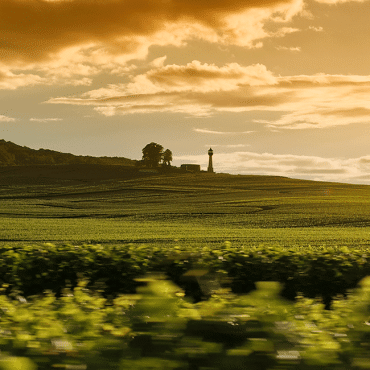
The four seasons of the wine cycle
The vine lives to the rhythm of the seasons, and every year history repeats itself. Yet every vintage is different. That’s the magic of Champagne!
Spring
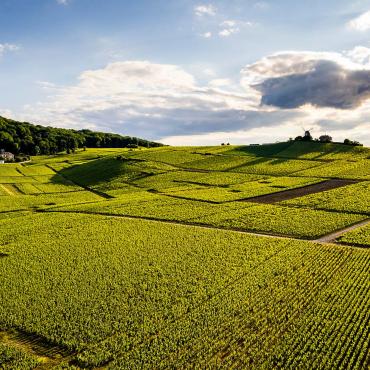
Vegetation is starting to cycle again, and the stakes are high: the quality of the spring (vineyard work, weather, etc.) is a guarantee of the harvest to come. Winegrowers are constantly on the lookout for ways to maintain the vines on a daily basis. Tying, disbudding, lifting, trellising – there’s no shortage of work to be done in the vineyard!
Summer
The vines remain at the heart of the concerns of winegrowers, who continue to pamper them every day. This is the time for trimming, also known as “summer pruning”. The weather also plays its part, more or less favorable depending on the year.
Autumn
It’s time for hand-picking, even if this now tends to take place in summer, often in September or late August. Observation of the vines indicates the best time to harvest the grapes. Each harvest is different from the last in terms of grape maturity, acidity and alcohol content. All the players in the Champagne region are mobilized for this crucial stage in the viticultural cycle.
Winter
After the harvest, the vine loses its leaves, leaving the field free for vine maintenance. The vine “sleeps” for a few months. The sap falls back into the roots. This is called “dormancy”.

Early January is the ideal time for pruning, according to the 4 types* required by Champagne regulations.
Champagne grape varieties
The nature of the terroir has guided the selection of the best-suited grape varieties.
Today, three grape varieties are in the majority: Pinot noir, Meunier and Chardonnay.
Older varieties (Arbane, Petit Meslier, Pinot Blanc and Pinot Gris) are also authorized, but remain anecdotal in terms of the proportion of vineyards planted.
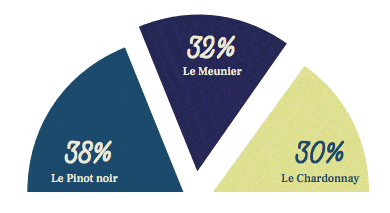
L’Arbane, Petit Meslier, Pinot Blanc and Pinot Gris account for less than 0.3% of the vineyard. Pinot Gris and Pinot Blanc emerged from mutations of Pinot Noir. Petit Meslier is a cross between Gouais and Savagnin. Finally, Arbane is a grape variety whose origin remains a mystery to this day.
Champagne cuvées
Each winemaker, each House, produces its own cuvées to create its own range of champagnes.
The name of a cuvée comes from its blend (the different wines that make it up) and/or its dosage (the sugar content).
- The brut “non-millésimé” is a blend of several years. It is a champagne classic, representative of the House’s style. A non-millésimé can be blended in different proportions.
- Vintage wines are made exclusively from the same vintage. We choose to vintage a wine when the harvest was exceptional, which gives it great character.
- This original, full-bodied rosé is made by maceration of black grapes (rosé de saignée) or by blending still, non-sparkling red wine from Champagne (rosé d’assemblage). It is the only French wine that can be made using this technique.
- The Cuvée Spéciale, vintage or not, is composed of the most subtle wines. It is an exceptional cuvée that contributes to the prestige of a House and reveals its savoir-faire.
The term “cuvée” initially refers to the first juices extracted during pressing at harvest time (i.e. 20.50 hl from a 4000 kg marc). These very pure juices produce wines of great finesse, with subtle aromas.
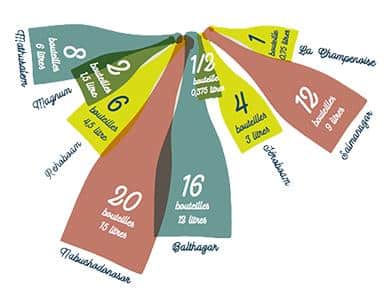
The different bottles of Champagne
“The bottle doesn’t matter, as long as you get drunk.
Alfred de Musset’s words are as elegant as ever, but the fact remains that alcohol is a pleasure to be consumed in moderation!
Champagne tasting
5 tips for serving champagne like a pro
# 1 – Serve champagne at the right temperature
That means cool, at 8 or 9°C. However, some cuvées, such as old vintages and special cuvées, are best served around 10 or even 12°C. Ideally, 2/3 of the bottle should be immersed in an ice bucket for 20 minutes. Failing that, chill your bottle in the least cold part of your fridge to preserve the wine’s qualities for drinking. Avoid the freezer at all costs!
# 2 – Open the bottle correctly
To open the bottle, tilt it slightly and release the loop on the wirehood. Then remove the wirehood and liner, holding the cork with your thumb and the bottle upright. Then, still holding the cork firmly, grasp the body of the bottle and turn it to gently release the cork from the neck without letting it escape. Normally, you should hear a delicate “pschitt” rather than the famous “pop”! Finally, remember to taste the champagne before serving.
# 3 – Serve champagne in clean glasses
Washed in hot water. In dishwasher-washed glass, the bubbles don’t open as they should. It’s best to wash the glass in hot water, without any detergent, and leave it to dry. To avoid traces of limescale, you can wash it in hot water with a little white vinegar.
# 4 – Serve champagne in appropriate glasses
In other words, in a flute. It’s best to enjoy champagne in tulip-shaped glasses with a large container (20 to 30 cl) to give the bubbles room to develop and allow the aromas to express themselves.
# 5 – Serve champagne with style
Hold the bottle by the base, not the neck. The ceremonial of serving champagne is just as important as the champagne itself. The bottle should be held with one hand by the base, which has a conical cavity called the piqûre. To make serving easier, you can put your thumb in the piqûre.
QUIZ
HOW FAST CAN AN UNCONTROLLED CHAMPAGNE CORK GO?
- 20 KM
- 40 KM
- 80 KM
RESPONSE
At serving temperature (8/10°C), a bottle of champagne expels the cork at 40 km/h. The cork leaves the bottle at a speed of 13 metres/second, at a distance of one metre, so it is likely to reach 40 km/h in less than 1/10th of a second.
Les ateliers “Champagne” – Champagne Telmont
Damery
At Maison J. de Telmont, the art of receiving guests has always been highly prized.
Come and spe…